AI in the classroom:
from basic knowledge to sustainable practice
A professional, evidence-based programme lasting one school year that provides step-by-step guidance to teachers and support staff on the responsible and inclusive use of AI in their school.
🕒 A full school year of support
🏣 An in-person kick-off day to set the scene and discuss the approach
🔬 Tailored research: using surveys of your pupils and teachers as a starting point
📹 8 online webinars to help you prepare for school sessions
💻 Technology-agnostic (Google, Microsoft, OpenAI, Anthropic, GROK, etc.)
📖 An evidence-based approach based on research and coaching
Who is this programme for?

Teachers who take the lead
You take the lead and get your colleagues on board. You don’t need to be an AI expert, but you do need to be curious and willing to experiment.

IT coordinators
You translate technical knowledge into an approach that works in the workplace. This course will provide you with the teaching tools to do so.

Senior management and middle management
You want to develop an AI policy that has broad support. This process is based on the needs of your own school and team.

Educational IT Coordinator
You are at the intersection of education and technology. This course provides you with a well-founded framework for effectively integrating AI into your teaching practice.
What makes this programme different?
This programme is not based on a generic curriculum, but on your school’s specific needs. Before we begin, we’ll carry out a scientifically based survey of your pupils and teachers to ensure the plan is fully tailored to your requirements.
Our approach is technology-neutral: we cover Google, Microsoft Copilot, ChatGPT, Claude, Grok and other tools. We are not tied to any single platform or supplier.
In doing so, we pay particular attention to the GDPR and data security: which tools are suitable for use in schools, which are not, and how schools can handle pupil and teacher data responsibly.
Inclusion is not a secondary objective, but the central theme: AI as a means of reaching every pupil, based on Universal Design for Learning (UDL) and the AI Compass.
After 22 weeks, the results are measurable: a baseline and final assessment provide a clear picture of how AI usage and attitudes have evolved at your school.
In practical terms, you will receive:
- Fully prepared materials for each session
- Flashcards and worksheets (customisable to suit your school’s style)
- Your own digital AI hub for your school (we’ll build it together)
- A weekly news article as an asynchronous learning resource
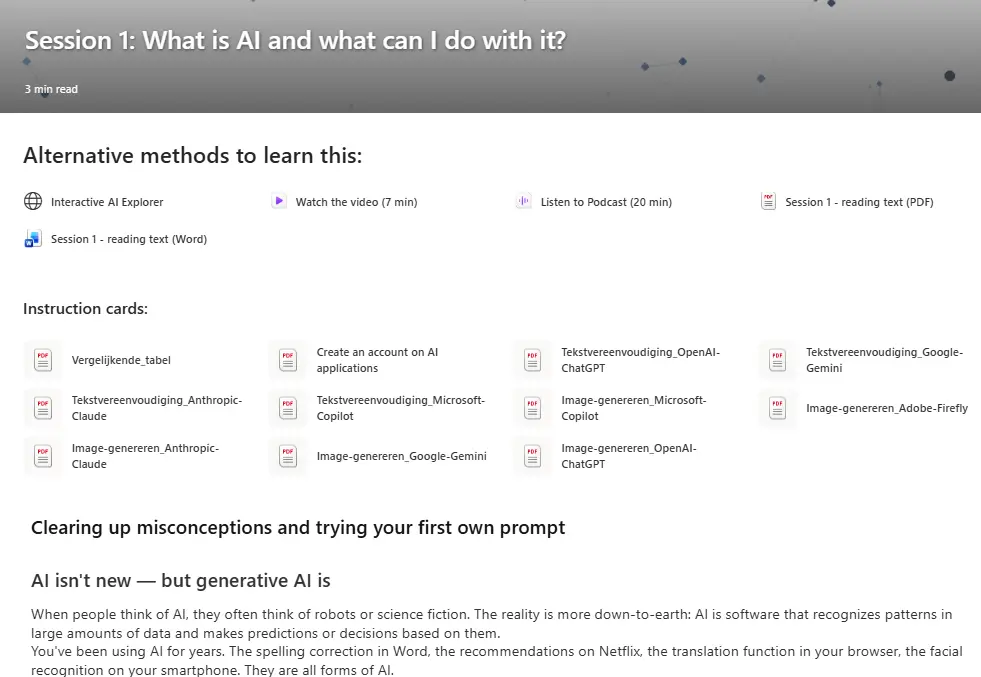
What does the process look like?
The programme runs over one school year and is structured in six distinct phases.
Each phase builds on the previous one.
Introduction to the process and tools
We’ll explain the structure and methodology of the programme, explore the research methods, and provide you with all the materials you need to organise the survey at your school. Practical, hands-on and immediately applicable.
Research at school
You will carry out three research methods at your school: an AI survey among pupils, an AI survey among teachers, and a number of semi-structured interviews with participants.
Edu-versity begeleidt je doorheen dit proces.
Analysis and bespoke plan
During an online session, we analyse the research data together using an AI agent and draw up a personalised implementation plan for each school.
OWe will determine the focus and order of the sessions based on your needs.
Build your own AI hub
Together, we will build a bespoke digital learning environment (AI Hub) and a registration tool for your school. You will receive index cards and information sheets that you can customise to match your school’s branding.
This is your sustainable knowledge base for the process and beyond.
8 Webinars
There is an online webinar every two weeks (1 hour, on an evening of the group’s choosing).
The webinars are deliberately not recorded in order to ensure active participation and group dynamics.
8 sessions
The week after each webinar, you will deliver the session yourself at your school.
Edu-versity provides the materials; you know your colleagues.
Final assessment and reporting
After the eight sessions, you will conduct a final survey among the participants.
You will receive a clear report that provides a measurable overview of trends in AI usage and attitudes.
Concrete evidence of the programme’s impact on your school.
Supported by research and educational theory
This programme is not based on hype, but on proven pedagogical models and educational research. Inclusion is not a secondary objective, but the very reason why the programme exists: AI as a means of reaching every pupil, including those who are currently left behind.
The approach builds on participants’ existing strengths, rather than focusing on what they do not yet know. An initial survey of both pupils and teachers shapes the content of the sessions. A final assessment demonstrates the impact.
Not a training course you simply attend and then forget, but an action research cycle that will help your school make lasting progress.
Universal Design for Learning (UDL)
AI as a means of delivering learning materials in a variety of ways, so that every pupil is reached — including those with special educational needs.
Strength-based coaching
The programme focuses on participants’ strengths and core qualities, rather than their shortcomings. Based on core reflection (Korthagen & Nuijten).
Participatory research
Your school’s needs are identified using scientifically proven methods: surveys, interviews and data analysis.
Distributed leadership
Change within organisations is successful when it is driven by people on the shop floor, rather than imposed from above (Spillane, 2006).
Action research as a method
Every two weeks, we review and adjust our approach based on experiences in the workplace. The process is guided by practical experience, not the other way round.
Technology independence
The course teaches you to think about AI, not just a single tool. Each session covers multiple platforms so that you aren’t tied to a single provider.